NOTICE by Paul Vangelisti By way of a notice of Bill Mohr’s new book, Remiges: Three Extended Poems, 1980-2025, from What Books Press. Earlier this year, while writing a blurb for Remiges, plural of remex (larger wing feathers helping birds lift, soar, change directions), I landed upon Remigio Rapalli, grandfather’s first cousin. Then to the Italian feathers, penne remiganti, and back to the Latin remigere, to row, remex, rower, or remigium, oar.
In California, right after the Great War, cousin Remigio would become Ray Rapalli. Remigio seems of Latin origin, after the 5th century Remigius, bishop of Rheims, who was said to have baptized the King of the Franks. Besides the first oar of Christian France, the name also suggests “healer” or remedium, as well as citizen of Rheims.
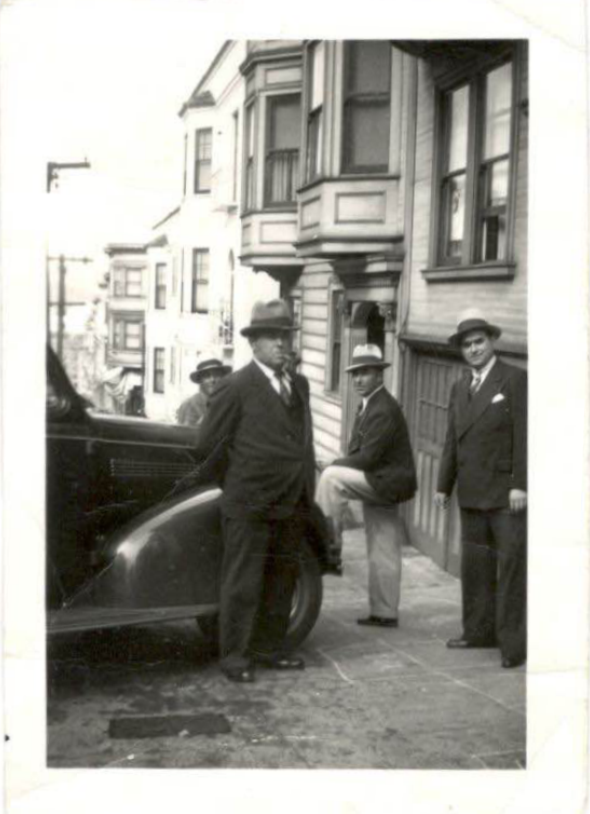
Cousin Ray, acting as his immigration sponsor, enabled nonno Guido to take flight to California in 1923. Without a word of English, after a five-day sail from Genoa to Ellis Island, and an interminable train ride across the U.S., Guido showed up at the Weed Hotel, just south of the Oregon border, asking for Ray Rapalli.
As for the surname Rapalli (nonno’s mother a Rapalli ), time (and mother’s death in 2015) deny great-grandma’s given name. Rapalli yields the Latin rapulum, rapa or little turnip, to the Italian rapa, turnip, pointing to agricultural practices. Or, the geographical location just north of us on the Ligurian coast. For me, Rapallo holds some fascination as exile households for Ezra Pound and Yeats, but the place itself has no connection to us and Bagnone or the rest of Lunigiana.
One curious bit of family lore concerning great-grandmother Rapalli. My grandfather, grandmother and my mother all recount that La Rappali was always excused (by patriarch Luigi Zangani) from working in the fields, as was no one else on that hardscrabble piece of land. La Rapalli mostly stuck to her room on the top floor of the little house and sang. Most of the morning and evening, she sang, in what was said to be an angelic voice, for her husband and children toiling on the hillside below. That room at the top, overlooking the valley, is now the studio where I scribble.
On a lighter note, the remiges or penne remiganti are the fallen bird feathers that once became the quill of a different kind of bird, the poet or scribe. In all, these would-be etymologies attest to that most telling of West Coast dicta, noted by Spicer in After Lorca: “Things do not connect; they correspond.” And so it is with Bill Mohr’s arresting and important new book Remiges: Three Extended Poems, 1980-2025 (What Books, 2026)
Thus, we have come to inhabit the light in the silent House that Jack built.
Thanksgiving, 2026

Remiges: Three Extended Poems (1980–2025)
Bill Mohr
What Books Press, 2026
You may also be interested in:


Edited by Bill Mohr.
Bruce Boyd’s first book, Toward Morning: Selected Poems, is the most startling posthumous debut of any poet of the past century. Toward Morning, therefore, represents a massively overdue publication of a poet whose work appeared alongside the writing of Gary Snyder, Jack Spicer, and Stuart Z. Perkoff in such journals as Evergreen Review, Yugen, Measure, and Spicer’s legendary magazine, J. Boyd lived and wrote his poems in San Francisco, Berkeley, and Venice West, moving back and forth with an emblematic restlessness often associated with mid-century mendicant poets. Elusive as he was as a person, however, the themes of his poems point to the embodying value of an enduring vision, now finally if belatedly shared, and deserving of slow absorption and grateful celebration.
ISBN: 979-8-9926955-1-9
Pub. Date: April 15, 2026