Primordial: Poems
Mai Der Vang
Graywolf Press, 2025
REVIEW by S. E. Pessin Mai Der Vang's third book, Primordial (Graywolf Press), extends her examination of the Hmong culture during and after the Vietnam War. Whereas in Afterland (2017) and Yellow Rain (2021) it can be argued that their foci are split among the catastrophic displacements endured by the Hmong and documentary reactions to war crimes committed by the United States in Cambodia, Laos, and Vietnam, in this volume, there is a greater emphasis placed on ecological flows by taking as a central subject of the book the figure of a saola.
The saola, or Vu Quang bovid, is a horned and hooved animal first classified in binominial nomenclature in 1993. Of course, this creature existed long before western science labeled them. They are genetic relatives of goats and buffalo; their last common cladistic ancestor is estimated to have left the bovini family between 10.8 and 16.2 million years ago.
It is assumed that the last confirmed sighting was in 2013 on a capture camera used for forest surveillance.1

Poetry, October 2021
Book designer Rachel Holscher's 7" x 9" perfectbound paperback format is expansive and makes space for the slimmer poems to breathe while also accomodating later concrete poems and word art. The text block has a typical sizing: 7/8" at the margin, 5/8" at the head, and 1" at the foot. The face selected for the book, Adobe Caslon Pro, is modeled off a face designed by William Caslon and redrawn by Carol Twombly for Adobe. The paper, a textweight cream, is comfortable on the eyes, is printed and bound by Sheridan.
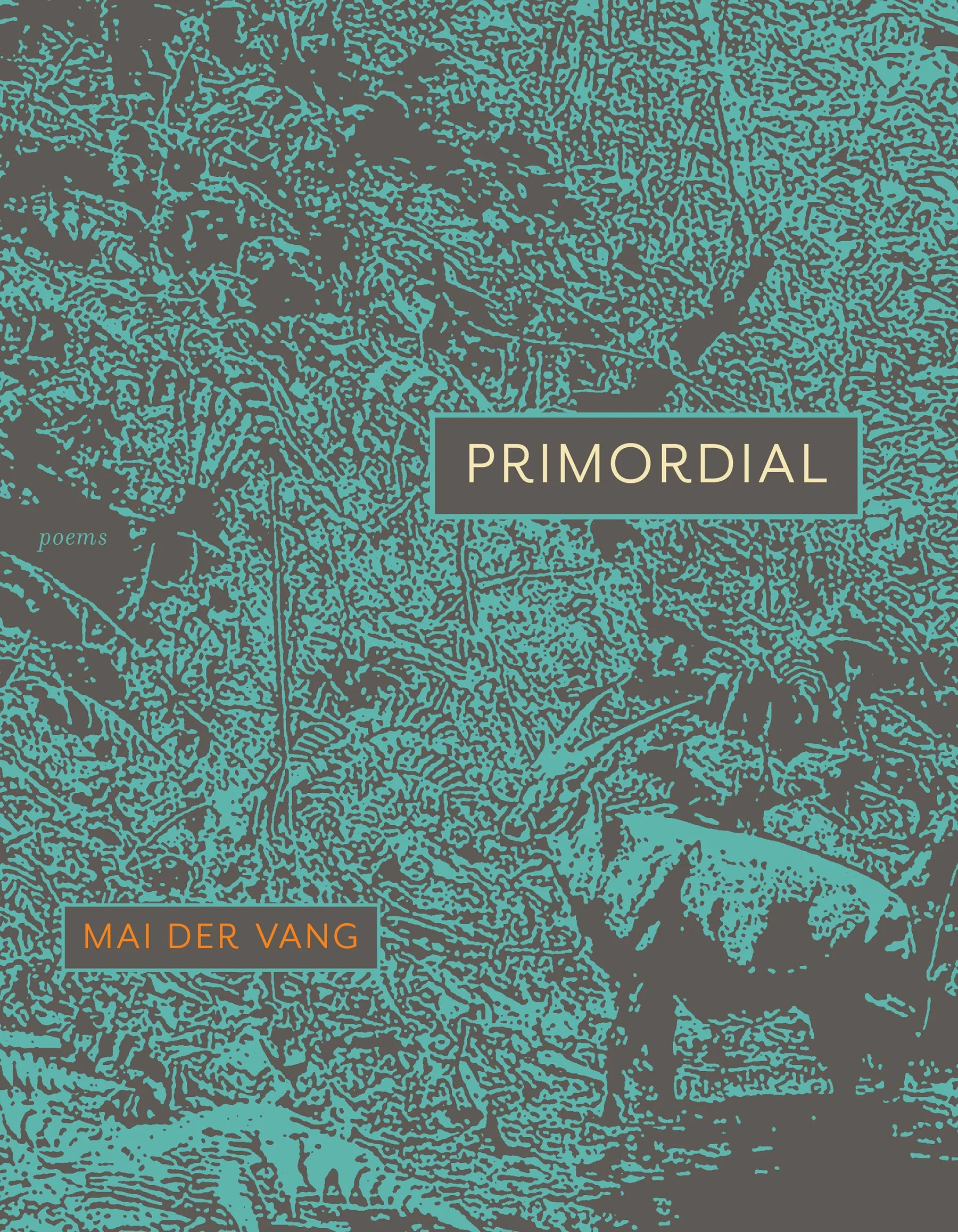
The cover, by Jeenee Lee, is also lovely. Artistic estrangement is achieved by the teal-on-gray transformation from the original saola photo inspiration, shot by William Robichaud of Ban Vangban Village for Wildlife Conservation Society:

The manipulation of the image into a scanner-like low-res simualtion of turquoise light or gray shadow well-exemplifies the themes of the book by causing the saola to be present and overlookable, to be visible and flattened into a one-dimension encounter with the natural world.
notes